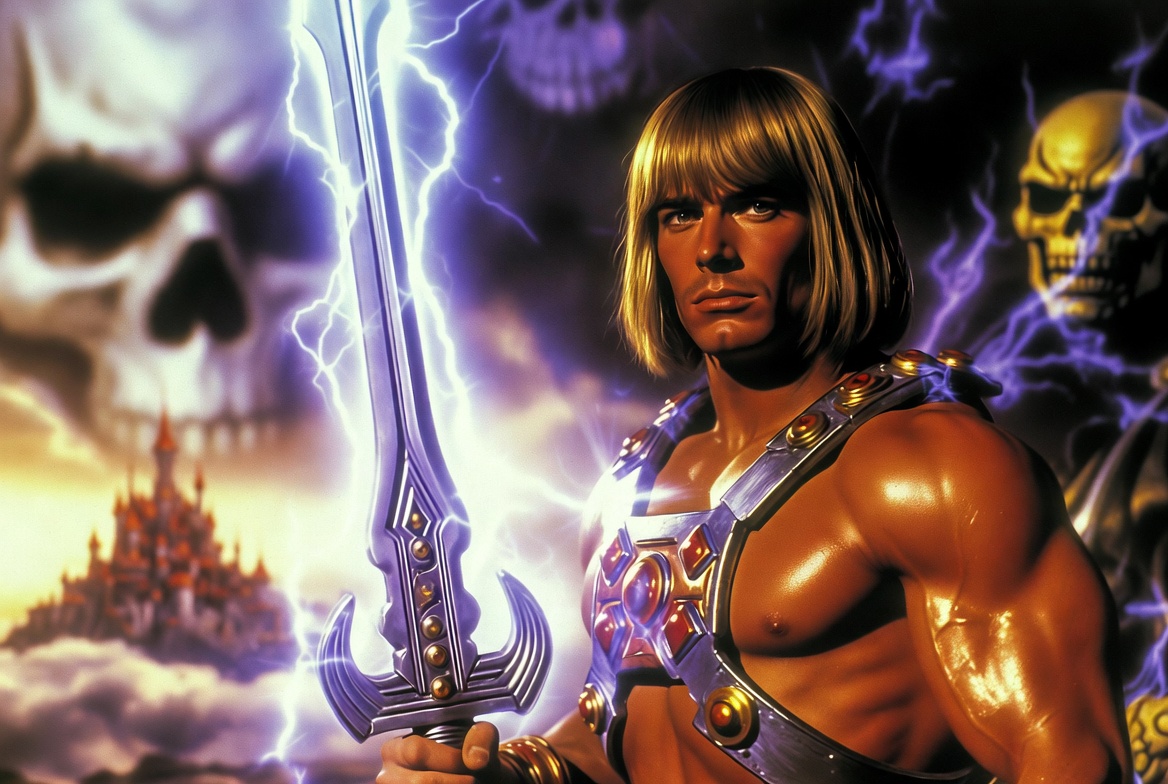
Travis Knight’s live-action swing at He-Man is a mediocre movie with a couple of genuinely good ideas buried inside it, and that combination is more frustrating than a flat-out bad film would have been. You can see the movie this could have been in flashes — it just rarely commits to it.
Let’s start with what works. The production design is a real strength: Eternia looks like the toy line and cartoon come to life, all bold color and oversized silhouettes, without tipping into the washed-out grimdark look that sank the 1987 version. And Skeletor is, against my own expectations, the film’s best creative decision. Jared Leto plays him with a fully committed, campy theatricality — a skull-faced menace who’s never handed a tragic backstory or a sympathetic motivation, because he doesn’t need one. He’s evil because he’s evil, and the film is smart enough to let a side character just say so out loud instead of manufacturing pathos for him. It’s a rare case of a modern blockbuster resisting the urge to humanize its villain into mush, and it gives the character a cartoonish menace with just enough physical presence and voice work to feel like a real threat rather than a punchline.
Everything else, though, is where the film falls apart. The decision to open on Earth — with adult Adam grinding through a dead-end HR job, pining for a sword he lost as a kid, treated by everyone around him as a delusional loser — is a miscalculation from the first scene. Nobody bought a ticket to Masters of the Universe to watch a mopey guy get talked down to in a cubicle. It delays Eternia, delays the actual mythology, and front-loads the film with a fish-out-of-water comedy that has nothing to do with what makes this property appealing in the first place. It’s not hard to see why a chunk of the built-in fanbase simply checked out before the movie even got to the parts they were promised in the trailers.
That Earth-bound framing is also where the deeper problem starts: this is a franchise that was built, unapologetically, for young boys — a power fantasy about becoming the strongest man in the universe — and the film seems almost embarrassed by that premise. Prince Adam is written as a bumbling, dependent doofus who needs Teela to rescue and reassure him at every turn, right up through his arrival back on Eternia. There’s a version of “reluctant hero finds his confidence” that works, but this Adam never quite earns his transformation; he’s a punchline first and a hero second, and the shift from one to the other doesn’t land. Man-At-Arms suffers a similar fate, reduced to a broken-down, drunken has-been rather than the steady, competent mentor figure the character has always represented. Watching two of the story’s central male figures get systematically diminished — one played for bumbling laughs, the other for pity — undercuts the entire point of a story about growing into strength and responsibility. If you strip out the aspirational core of “the most powerful man in the universe” and replace it with self-deprecating irony at every turn, you’re left with a movie that doesn’t seem to trust its own premise, or the audience it was originally made for.
The result is a film that looks the part and gets its villain right, surrounded by a story that keeps undercutting itself. It’s watchable, occasionally fun, and forgettable — a movie made by people who clearly love the aesthetic of Masters of the Universe but seem uncertain, or even a little embarrassed, about what the story was actually supposed to be for.